Most studio software was built for gyms, salons or large chains. A small studio needs something simpler: classes on a schedule, students who book their own spot, class packs that go down with every visit, and payments that match what happened in the room. This guide compares seven tools, says who each one is for, and then walks through what to look for in a yoga, pilates, dance or barre studio.
It was written by the team behind Ulumi, so you should know our view up front: for one small studio where the owner also teaches, we think Ulumi is the simplest choice, and that is why we built it. We show our sources and our limits so you can check us.
What a small studio actually needs
Long feature lists make every product look the same. For a studio with one location and a handful of teachers, five jobs decide whether a tool is a good fit.
- A schedule that repeats. You should set a weekly class once, not add it again every week.
- Booking that students can do alone. A link or an app, with spots that fill and a waitlist when a class is full.
- Class packs and memberships. The system should know how many classes each student has left and take one away at check-in.
- Payments you can see. Card, plus the ways your students really pay, such as Venmo, Zelle, Cash App or cash, in one list.
- Reminders and receipts. Fewer forgotten classes and fewer questions about what someone paid.
If a tool does these five well and quickly, the rest matters less. If it does them but takes ten taps for each, you will feel it every day.
Seven options compared
| Software | Built for | What the company publishes about price | Good to know |
|---|---|---|---|
| Ulumi (our app) | One small studio where the owner teaches | $49 a month after a 14-day free trial | iPhone app for you; students use a web link |
| Mindbody | Larger and multi-location businesses | Starter from $79 a month per location; other plans on request | Many features, more to set up |
| Vagaro | Salons and wellness, with a fitness product | One Location plan $23.99 a month for the first 6 months, then $30; 30-day trial | Salon and spa first; extra calendars are $10 each |
| Glofox | Gyms and boutique fitness | No public price; you ask for a quote | Branded app and text messages reported as extras in reviews |
| Momence | Boutique studios | No public price; you ask for a quote | Free trial button and a pricing form |
| TeamUp | Studios and gyms of many sizes | $189 a month for 101 to 200 active customers on its pricing page | Price grows with active customers; add-ons cost extra |
| Junocal | Solo instructors and small studios | Free plan with a 4% payment fee; Starter $15, Studio $29, Growth $69 a month (its own price list) | A new product, 14-day trial |
Prices change, and sources do not always agree. These were last checked in November 2026, so confirm the current number on each company's own site before you decide.
What to look for, by type of studio
The same software can fit one kind of studio and annoy another. Here is what usually matters in each.
Yoga studio software
Yoga studios mix drop-ins, class packs, unlimited memberships and the occasional workshop, often with several teachers. Look for: packs that do not mix up with memberships, easy workshop sign-up, and a student view that shows classes left. If your schedule changes from season to season, check how fast you can move or cancel a class and tell everyone who booked.
Pilates studio software
Pilates classes are small and the equipment is limited, so each spot matters. Look for: a hard cap on spots, a waitlist that fills a cancelled spot, and a clear late-cancel rule. When a reformer class has eight spots, one no-show costs real money, so the cancellation and no-show settings are worth testing before you pay.
Dance studio software
Dance studios often run in terms or seasons, with kids and adults in the same building. Look for: class lists you can check against who actually paid, a way to send one message to a whole class, and billing that works for a parent paying for more than one child. Not every tool in this guide handles family billing, so ask about it before you sign up.
Barre studio software
Barre is a boutique format: packed classes, class packs, and many members who come three or four times a week. Look for: fast check-in at the door, packs that are easy to sell in person, and reminders that cut down on empty spots. If you also sell merchandise or run a small shop, check that the tool covers it.
The options, one by one
Ulumi (our app)
Best for: one small studio where the owner also teaches and wants to run the day from a phone.
Ulumi covers the daily work: a schedule that repeats, a booking link students open in a browser, class packs and memberships, one-tap check-in, a list of every payment, and email reminders and receipts. Students do not install anything: they open your link, book a spot, buy a pack and see how many classes they have left. Payments can go by card straight into your own Square account, and you can record Venmo, Zelle, Cash App or cash.
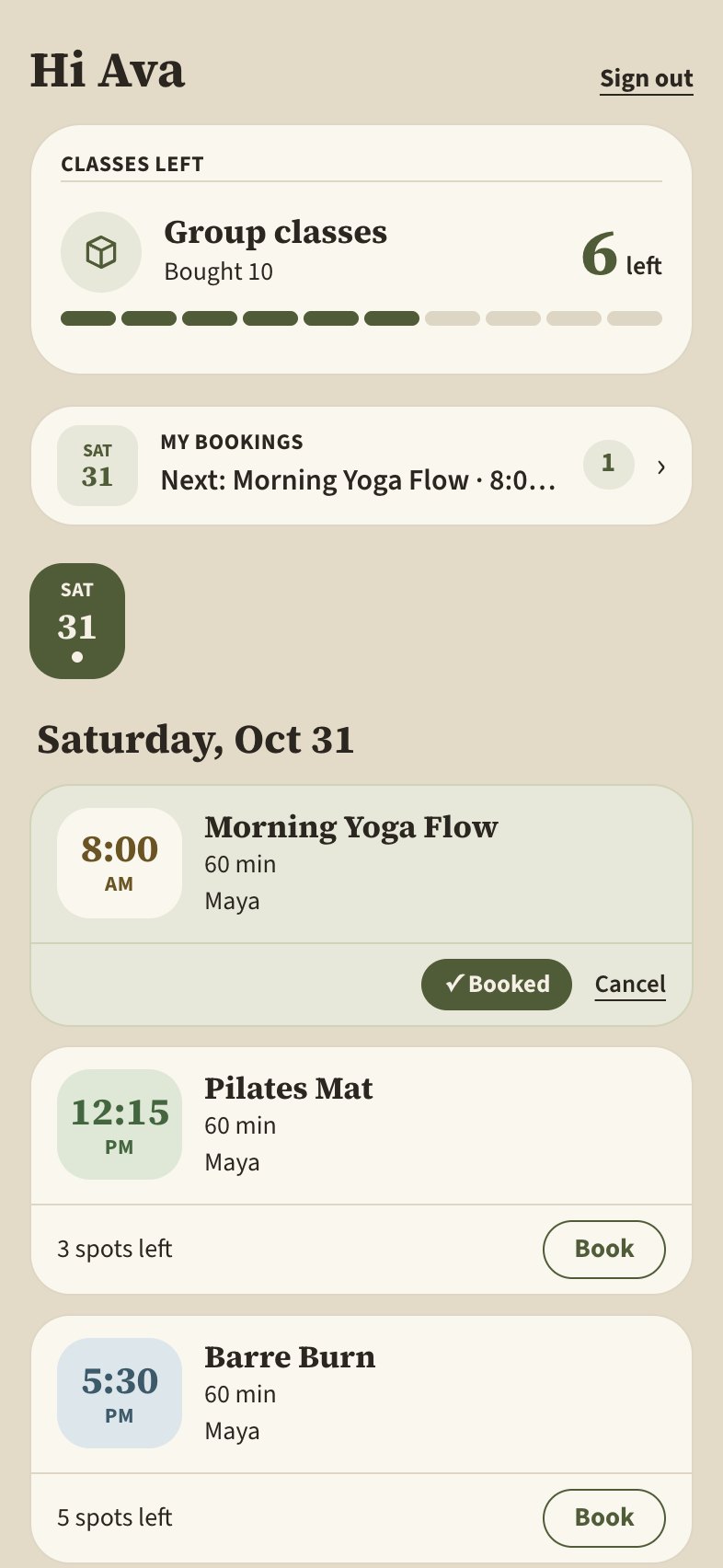
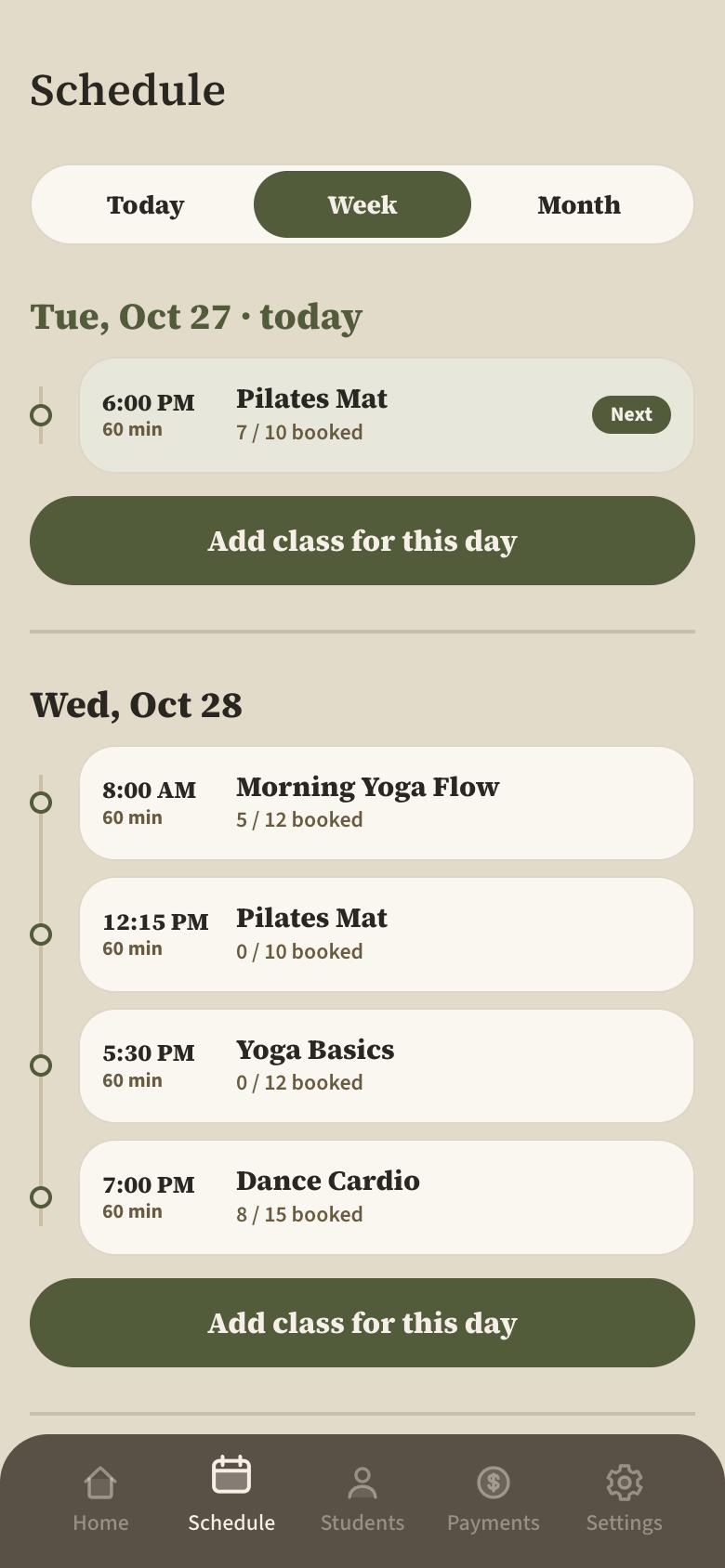
It costs $49 a month after a 14-day free trial, and you can see the price before you start. You subscribe in the app with your Apple ID and can cancel in your iPhone settings.
Mindbody
Best for: larger studios and businesses with several locations.
Mindbody lists its Starter plan from $79 a month per location and quotes higher plans individually, with a card processing fee on top. Its own pricing page says it may not suit independent one-person operators who need only basic booking and payments. It has the longest feature list on this page, which suits a large business and can feel like too much for a small one. Some reviewers report a 12-month commitment, so read the current contract terms. We wrote a longer guide on this: Mindbody alternatives for small studios.
Vagaro
Best for: studios that also sell salon, spa or massage services, or that want one tool for both.
Vagaro started in beauty and wellness and added a fitness product with class scheduling, memberships and online booking. Its pricing page shows the One Location plan at $23.99 a month for the first six months (then $30), with a 30-day trial and extra calendars at $10 each. Salon and spa businesses are listed first. Reviewers like how easy it is to use. Some fitness studio owners report gaps, such as no waitlist for classes and no way to move a client from one class to another, so test those before you commit.
Glofox
Best for: boutique studios that want their own branded app for members.
Glofox is aimed at small fitness businesses, and its branded app is the feature reviewers mention most: members can book and pay in it, and it supports push notifications. The company does not publish a price: its pricing page is a quote form. Some reviewers report extra charges for text messages and the branded app. The main complaint in reviews is reliability, so trial it on your own phone first.
Momence
Best for: boutique studios that sell a lot of memberships.
Reviewers credit Momence with strong class booking and membership management. The company does not publish a price: its pricing page has a free trial button and a form to ask for one. Common complaints in reviews are slow support and a booking widget that is not mobile-friendly.
TeamUp
Best for: studios and gyms of many sizes that want a long-standing, straightforward system.
TeamUp prices by the number of active customers. Its pricing page lists $189 a month for 101 to 200 active customers and no setup fee or contract, with add-ons such as a branded app costing extra. That model is easy to understand, but your bill goes up with every student you add. Check the current tiers on the company's own page.
Junocal
Best for: solo instructors and very small studios on a tight budget.
Junocal is a newer product for independent instructors and boutique studios. Its own price list shows a free plan (4% fee on payments) and paid plans: Starter at $15, Studio at $29 and Growth at $69 a month, with a 14-day trial. Payments go through your own Stripe account, which has its own fees. Because it is new, it has far fewer public reviews, so read the trial carefully and ask how your data can be exported.
How to choose in ten minutes
Ask every company the same four questions, and put the answers side by side.
- What is my total monthly bill for one location, one teacher and about 60 students, with card fees and every add-on I need?
- Do my students need to install anything, or can they book from a link?
- How long does setup take for a real week of classes, and who helps me do it?
- Can I leave easily? Ask about the contract length and how to export your students and their remaining classes.
Then start two free trials, add your real classes, book yourself in as a student and count the taps. The tool that feels quick on a normal Tuesday is usually the right one.
Studio software: common questions
What is the best software for a small yoga studio?
It depends on your size and on whether you teach. For one studio where the owner teaches, a lighter tool such as Ulumi or Junocal is usually enough. For a studio with several teachers and staff, Momence, Glofox or TeamUp are common picks.
Is there free studio software?
Most companies in this guide offer a free trial rather than a free plan, so you can test with your real schedule before paying. Check each company's page for the current trial length.
Can students book without an app?
It depends on the tool. Some give members a branded app, which is one more thing to install. With Ulumi students open a link in their browser, book a class and see their classes left, with nothing to download.
How long does setup take?
For one studio with a weekly schedule, plan on an afternoon: add your classes, your packs and memberships, and send your booking link. Bigger platforms take longer because there is more to configure.
Want to see how Ulumi compares with other kinds of studio software? Read the comparison, or try the free class pricing calculator to see what your classes should cost.
Looking at one kind of studio? Read the best yoga scheduling software or the best dance studio software. To set your prices first, see how much to charge for studio classes. Need studio paperwork? Use the free cancellation policy generator and waiver template generator.