Mindbody is the name most studio owners hear first. It is also built for larger, multi-location businesses, and a small studio can end up paying for tools it never opens. If you teach most of the classes yourself, you can compare the Mindbody alternatives below on three things that matter day to day: what they cost, how long they take to set up, and how well they fit a studio your size.
This guide covers six options, says who each one is for, and is straight about the trade-offs. It was written by the team behind Ulumi, so you should know our view up front: for a small studio where the owner teaches, we built Ulumi because we think it is the simplest choice. We show every price and every source so you can check us.
Why small studios look for Mindbody alternatives
Mindbody has a long list of features and a long list of happy customers. The reasons owners give for looking elsewhere are consistent, and they show up again and again in public reviews on Capterra. Here is what reviewers most often describe.
- Cost that grows. Reviewers say the price felt fair at the start and then grew with add-ons and card processing fees. For a studio with a handful of classes a day, that can be a lot.
- Contract terms. Some reviewers report a 12-month commitment they did not expect, and trouble cancelling before it ended. Contract terms change, so read the current ones before you sign anything.
- More system than you need. Owners of small studios describe a steep learning curve and many clicks for routine jobs like checking someone in or selling a pack.
- Support that varies. Some reviewers praise it, others struggle to reach anyone. Treat this as mixed rather than good or bad.
None of this means Mindbody is a bad product. It is a strong one for the businesses it was built for. The question is whether you are one of them.
What Mindbody costs in 2026
Mindbody's own pricing article, last updated in May 2026, lists the Starter plan from $99 a month per location. It does not publish a price for the higher plans, which are quoted on request.
Outside guides try to fill the gap and they do not agree. Some report Starter between about $99 and $159, a middle plan (Accelerate) around $260 to $280, and a top plan (Ultimate) near $500 a month per location, with an even higher tier above it. Treat those as rough guides, not quotes. Payment processing is charged on top of the plan, and so are some add-ons.
What to compare before you switch
Skip the long feature lists. Four questions settle most decisions.
- What will I really pay each month? Add the plan, card processing, and any add-on you need, such as text messages or a branded app. A low plan price with high extras is not cheap.
- How fast can I be teaching with it? You want to set up classes, sell a pack and take a booking in one afternoon, not in a week with a support call.
- Is it built for a studio my size? A tool made for one teacher and a tool made for ten locations answer different problems.
- Do my students need to download anything? Every extra step between a student and a booked class costs you bookings.
Mindbody alternatives at a glance
| Platform | Built for | What the company publishes about price | Good to know |
|---|---|---|---|
| Mindbody | Larger and multi-location businesses | Starter listed from $99 a month per location; other plans on request | Many features, more to set up |
| Ulumi (our app) | Small studios where the owner teaches | $49 a month after a 14-day free trial | iPhone app for you; students use a web link |
| Vagaro | Salons and wellness, with a fitness product | A solo plan is reported around $25 to $30 a month; fitness pricing by quote | Add-ons are billed separately |
| Glofox | Gyms and boutique fitness | Plans advertised from $99 a month; tiers by quote | Branded app and text messages reported as extras |
| Momence | Boutique studios | No public price; outside sources report roughly $60 to $200 or more a month | Request a demo for a quote |
| TeamUp | Studios and gyms of many sizes | Outside sources report about $119 a month for up to 100 active customers | Price grows with active customers |
| Junocal | Solo instructors and small studios | Starter $15, Studio $29, Growth $69 a month (its own price list) | A new product, 14-day trial |
Prices change, and sources do not always agree. These were last checked in October 2026, so confirm the current number on each company's own site before you decide.
Software similar to Mindbody, one by one
Ulumi (our app)
Best for: one small studio where the owner also teaches and wants to run the day from a phone.
Ulumi covers the daily work: a schedule that repeats, a booking link students open in a browser, class packs and memberships, one-tap check-in, a list of every payment, and email reminders and receipts. Students do not install anything: they open your link, book a spot, buy a pack and see how many classes they have left. Payments can go by card straight into your own Square account, and you can record Venmo, Zelle, Cash App or cash.
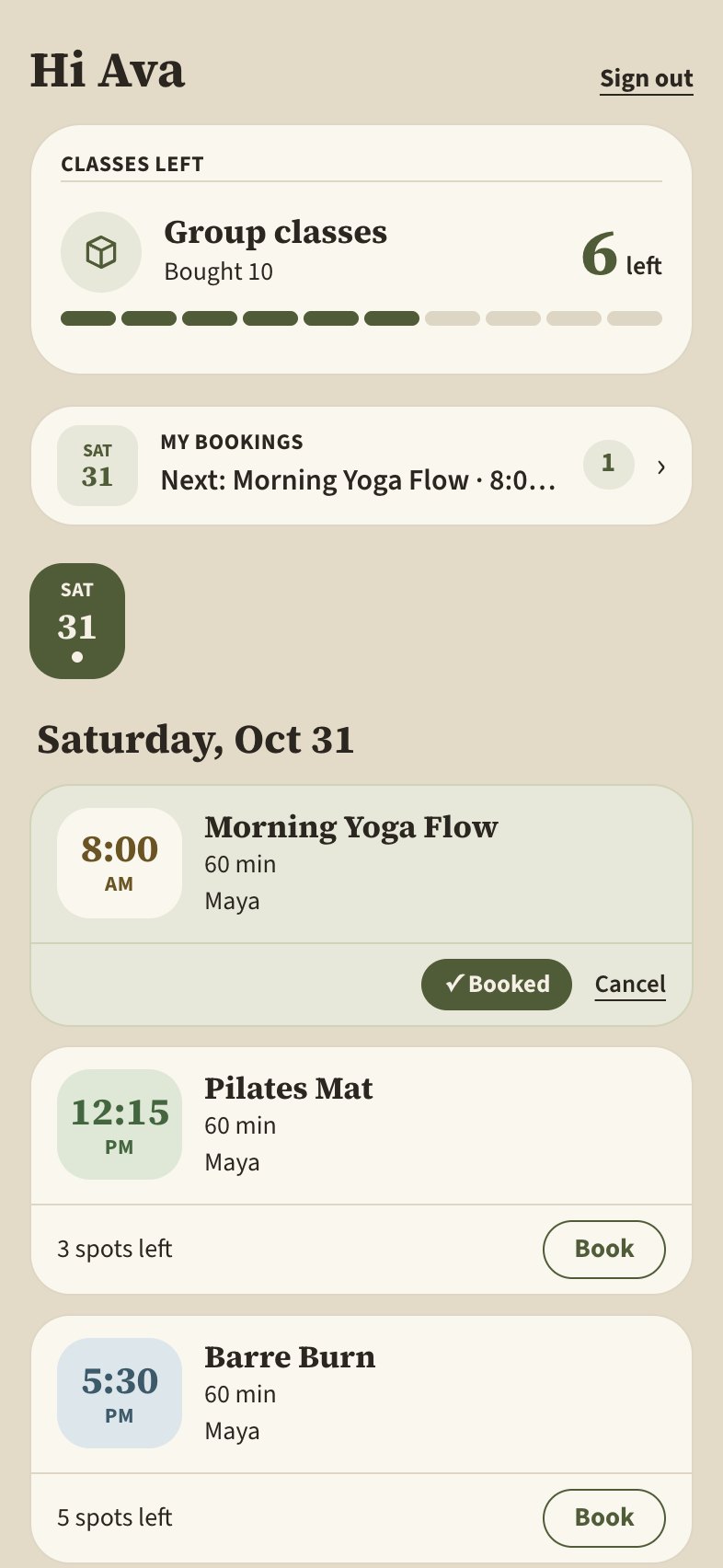
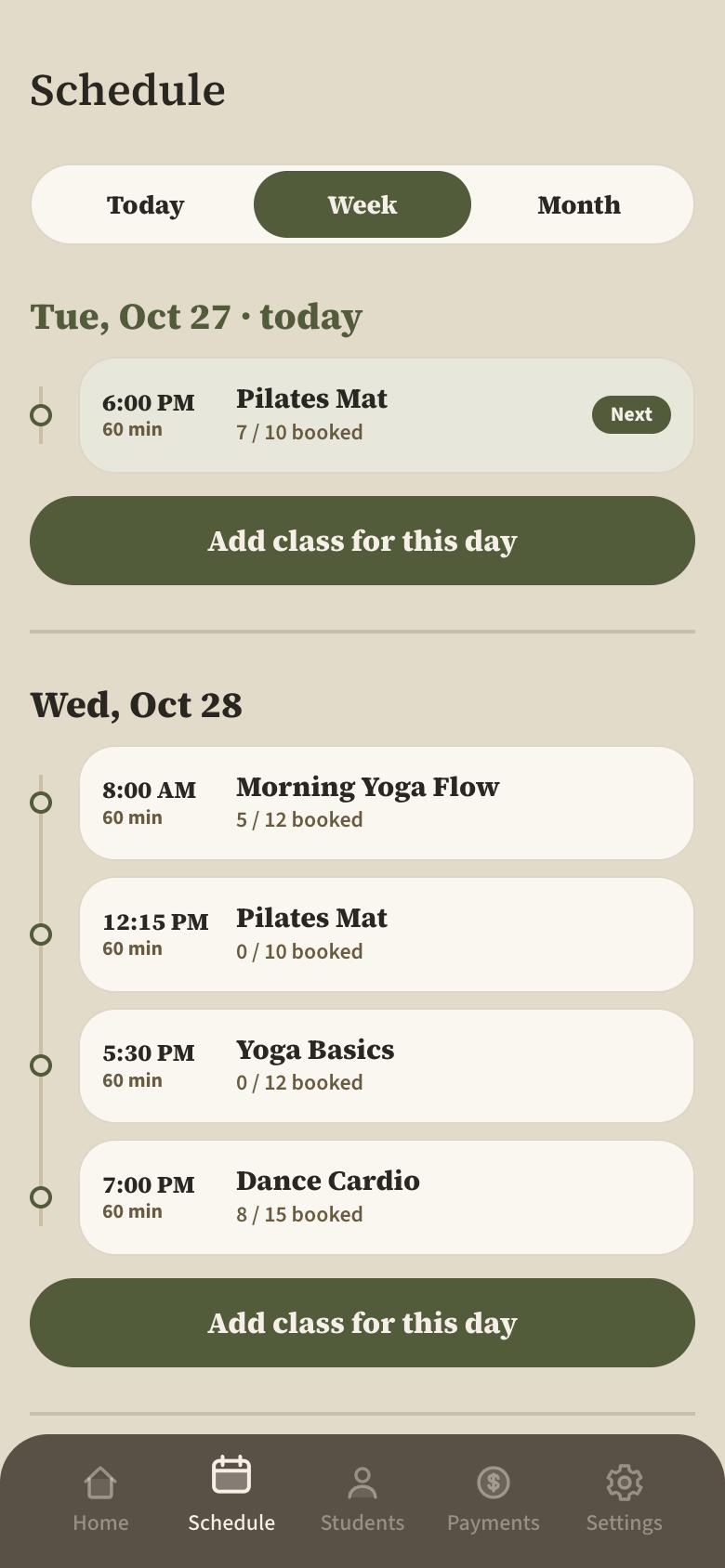
What you can do in your first afternoon:
- Add your studio and your weekly classes. They repeat every week, so you set them up once.
- Create your class packs and memberships, and decide what a late cancel costs.
- Copy your studio link and send it to your students.
- Check people in on class day and watch their classes left go down with each visit.
It costs $49 a month after a 14-day free trial, and you can see the price before you start. You subscribe in the app with your Apple ID and can cancel in your iPhone settings.
Vagaro
Best for: studios that also sell salon, spa or massage services, or that want one tool for both.
Vagaro started in beauty and wellness and added a fitness product with class scheduling, memberships and online booking. A solo plan is reported at roughly $25 to $30 a month for one bookable calendar, with fitness pricing quoted by the company. Reviewers like how easy it is to use and its client reminders. Some fitness studio owners report gaps, such as no waitlist for classes and no way to move a client from one class to another, so test those before you commit. Extras such as payroll, text marketing and a website builder are billed separately.
Glofox
Best for: boutique studios that want their own branded app for members.
Glofox is aimed at small fitness businesses, and its branded app is the feature reviewers mention most: members can book and pay in it, and it supports push notifications. Plans are advertised from $99 a month, with higher tiers by quote, and some reviewers report extra charges for text messages and the branded app. The main complaint in reviews is reliability, with some owners describing bugs and a gap between the web and the app. If the branded app is why you are looking, trial it on your own phone first.
Momence
Best for: boutique studios that sell a lot of memberships.
Reviewers credit Momence with strong class booking and membership management, and some like a simple admin side. The company does not publish a price: you start a trial or ask for a demo, and outside sources report anything from about $60 to $200 or more a month, plus card processing. Common complaints in reviews are slow support, plan changes that arrive without much notice, and a booking widget that is not mobile-friendly. It also has less to offer if you run several studios with different needs.
TeamUp
Best for: studios and gyms of many sizes that want a long-standing, straightforward system.
TeamUp prices by the number of active customers. Outside sources most often report about $119 a month for up to 100 active customers, with the price rising as you grow, and there is no free plan. That model is easy to understand but means your bill goes up with every student you add. Check the plans on the company's own page, because third-party listings disagree.
Junocal
Best for: solo instructors and very small studios on a tight budget.
Junocal is a newer product for independent instructors and boutique studios. Its own price list shows three plans, Starter at $15, Studio at $29 and Growth at $69 a month, with a 14-day trial and no transaction fee from Junocal (payments go through your own Stripe account, which has its own fees). The Starter plan is limited to one location and a small number of instructors. Because it is new, it has far fewer public reviews than the others, so read the trial carefully and ask how your data can be exported.
Apps like Mindbody for a solo teacher
If you teach most of your classes yourself, the list of things you really need is short: a schedule, a way for students to book, a way to sell class packs and take payment, reminders so fewer people forget, and an easy look at who has classes left. Anything beyond that is a bonus, not a requirement.
That is why lighter tools can feel better to use than a platform built for a large business. You open the app between classes, do the one thing you came to do, and close it. When you compare apps like Mindbody, put your own week next to each trial: add your real classes, book yourself in as a student, and see how many taps it takes.
How to switch from Mindbody without losing your students
- Check your contract first. Find the end date and any cancellation terms before you promise anyone anything.
- Export what you can. At least your client list and each student's remaining classes and memberships. Ask Mindbody support how to export if you cannot find it.
- Set up the new tool and test it for a week. Add a few real classes and book yourself in.
- Move students in small steps. Send one clear message with the new booking link and the date the old one stops.
- Keep both for a short overlap. Cancel the old plan only when the new one has run a normal week.
Class pack balances are the part to be careful with. Write down how many classes each student has left, so nobody loses what they paid for.
Mindbody alternatives: common questions
What are the best alternatives to Mindbody?
It depends on your size. For one small studio, lighter tools such as Junocal or Ulumi are usually enough. For a boutique studio with staff, Momence, Glofox or TeamUp are common picks. If you also sell salon or spa services, look at Vagaro.
Are there Mindbody alternatives for small studios?
Yes. Most of the tools in this guide were built with smaller studios in mind, and several have free trials, so you can test them with your real schedule before paying anything.
Is there a cheaper alternative to Mindbody?
Several are cheaper on the subscription, from about $15 a month up to the middle of the range. Look at the whole bill, though: card processing and add-ons can move the real cost more than the plan price does.
Do my students need an app?
It depends on the tool. Some give members a branded app, which is nice but is one more thing to install. With Ulumi students open a link in their browser, book a class and see their classes left, with nothing to download.
Want to see how Ulumi compares with other kinds of studio software? Read the comparison, or try the free class pricing calculator to see what your classes should cost.
- Mindbody: pricing in the United States (company)
- Mindbody reviews on Capterra
- Glofox plans (company)
- Glofox reviews on Capterra
- Momence reviews on Capterra
- Momence pricing (outside source)
- Vagaro reviews on Capterra
- Vagaro pricing guide (outside source)
- TeamUp pricing (outside source)
- Junocal (company price list)